
A ‘miraculous’ recovery: Reflecting on Chantal repairs one year later
July 8, 2026
Early in the morning on July 6, 2025, the National Weather Service in Raleigh updated the day’s forecast for Orange County: Tropical Depression Chantal would likely bring 1.5 to 2 inches of rain. A “reasonable worst-case scenario” for the day’s rainfall topped out at 3.1 to 3.7 inches.
What followed was unthinkable: over the next 24 hours, parts of Orange County received up to 10 inches of rain, washing out roads, carrying away cars, and stranding people in inundated homes.
For Rick, a homeowner in the Weatherhill Pointe neighborhood in Carrboro, how quickly the water rose was “downright scary.”
Water poured over the top of the University Lake dam, just upstream of Weatherhill Pointe, rising nearly eight feet over the flashboards and rushing into Morgan Creek and the neighborhoods below.
Rick, 78, recalls the floodwaters – really more of a “toxic, brown sludge” – bubbling up through the floorboards of his single-story home, eventually reaching 5 ½ feet deep in his garage and 23 inches in the home itself before beginning to recede. By that point, the damage was done: his walls, flooring, insulation, appliances, furniture, cars, and a good deal of plumbing and electrical wiring were ruined.
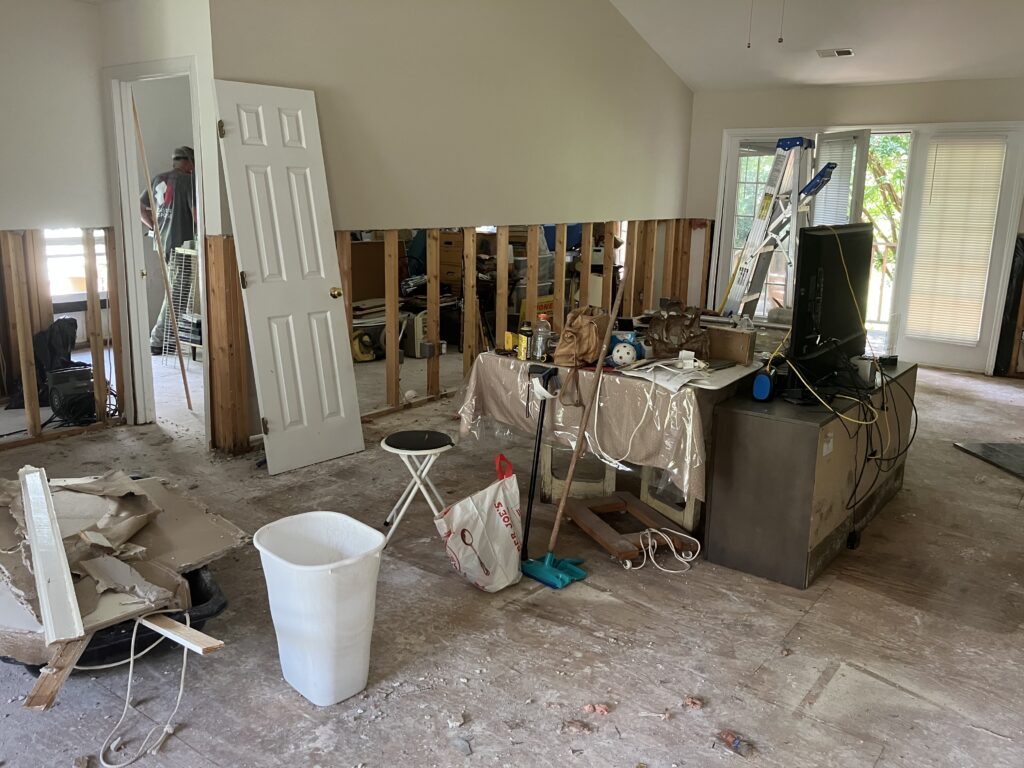
Floodwaters reached nearly two feet high in Rick’s home in Weatherhill Pointe. Drywall, flooring, insulation, doors, cabinets, electrical wiring, and plumbing fixtures had to be removed and replaced.
Initial cleanup takes many hands
A report from the National Hurricane Center stated Chantal caused an estimated $30 million in damage in Orange County. In Weatherhill Pointe, about 48 out of 56 homes flooded, and many homeowners were not prepared to bear the financial burden of repairs.
In 2017, the Federal Emergency Management Agency (FEMA) re-evaluated the neighborhood and declared that most of the homes fell outside of its special flood hazard area designation, where flood insurance was required. As a result, many homeowners cancelled their plans.
Without it, the out-of-pocket repair costs were impossible for many homeowners. “The entire community was traumatized,” Rick says.
In the first days after the storm, Orange Habitat joined rapid response cleanup and debris removal efforts alongside Team Rubicon, Triangle Mutual Aid, Reach Out Worldwide, and NC Baptists.
Rick remembers these early efforts with awe: with no electricity, the temperature in the house climbed to about 100 degrees, and volunteers were sweating it out in hazmat suits, ripping out drywall.
Orange Habitat Repairs Manager Taylor Phillips found Rick in his home and gave him the application for our Home Preservation program.
“When Taylor told me that they were going to put my house back together again, I almost couldn’t believe it. In looking around the house at that point, I almost didn’t think it was possible,” Rick says. For the next nine months, he stayed with relatives in Virginia as Orange Habitat conducted comprehensive repairs.
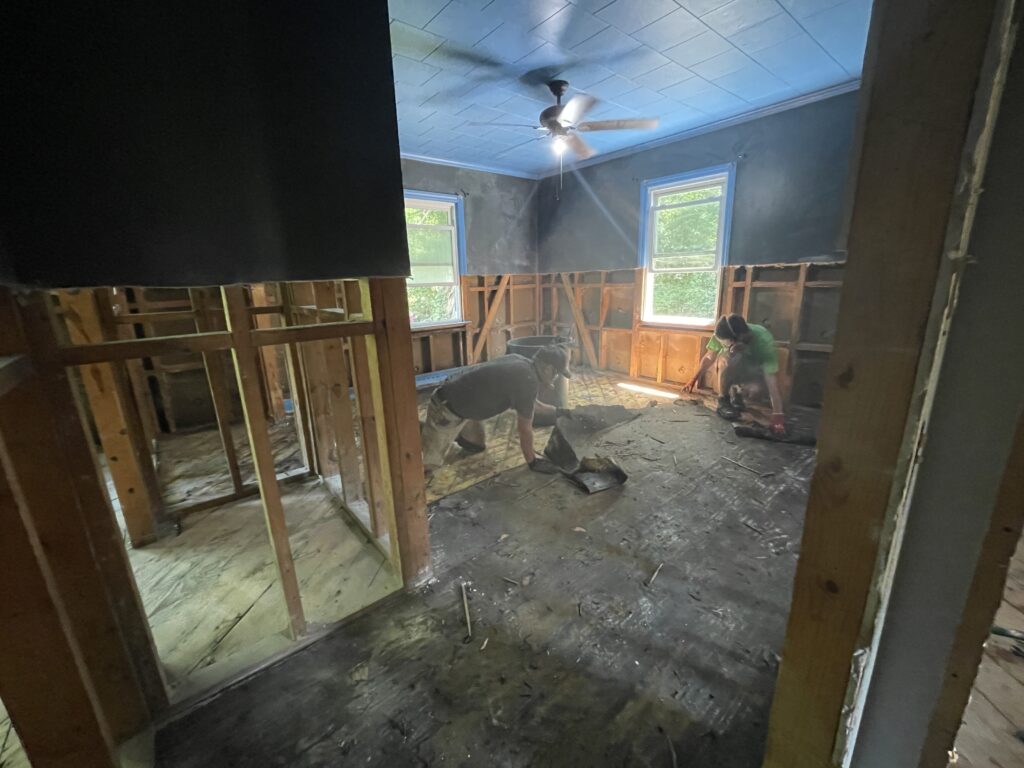
The Orange Habitat repairs team at work on a home near Booker Creek in Chapel Hill – another part of town that experienced severe flooding.
Repairs staff who were on the ground at the time recall how the initial rapid response support began to dry up after a week or two: while lots of organizations were able to mobilize volunteers to help with cleanup efforts, fewer were prepared to take on the long-term project of restoring a flooded home.
“There are a lot of organizations that exist for response, but there’s not much out there for recovery,” Taylor says. “If we hadn’t done it, I don’t think it would’ve happened.”
There was the work you could see, like reconstructing drywall and putting down flooring. But before that lay countless behind-the-scenes projects: Orange Habitat arranged for subcontractors to remove the soaked insulation from his tight crawlspace, dry everything out, and replace it. They hired electricians to rewire electrical outlets that had been submerged – and all the wiring connected to them. They replaced the plumbing, bathtubs, sinks, and countertops and added all new doors.
And they were coordinating these efforts for 10 local homes simultaneously – the most significant operational test the repairs program had faced to date.
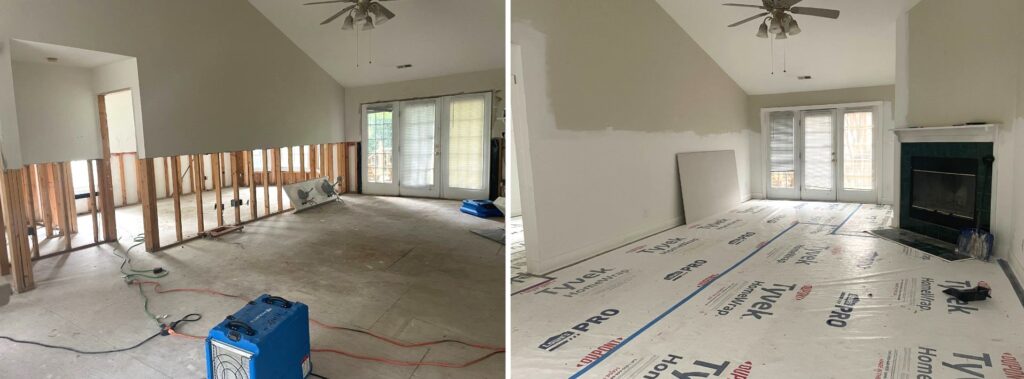
Rick’s home before and after drywall was replaced.
Growing the Home Preservation program
In normal circumstances, the Orange Habitat Home Preservation Program might manage a couple of active projects at once – only one of which would be a major overhaul. The program serves Orange County homeowners making under 80% of the Area Median Income (AMI), conducting critical repairs like HVAC replacement, roof or floor replacement or repair, and accessibility modifications like wheelchair ramps.
Flood damage is an entirely different beast: extensive dry-out, mold remediation, mucking, and gutting of flooded homes means those projects take longer and cost more than twice as much as standard repairs. Community support filled that gap.
Orange Habitat repairs staff handed out applications for our Home Preservation Program to any homeowners they could find in Weatherhill Pointe and neighboring Canterbury Townhomes, which had suffered similar flood damage.
In the end, they accepted every qualified application they received: four homes in Weatherhill Pointe, four in Canterbury Townhomes, and two elsewhere in the county.
These 10 comprehensive renovation projects totaled over $740,000 – funds far beyond the program’s typical budget. About $630,000 of that funding came from the Town of Carrboro and from grants from Verizon, State Farm, and the Oak Foundation. Individual community members gave $50,000 toward the cause, and Habitat for Humanity International also contributed.
This scale of repair work simply would not have been possible without this support. It was also made possible by dedicated Orange Habitat volunteers like Paul Hodulik, Mark Hauser, and Rick Tugwell, who returned to these repairs sites again and again in the months-long recovery process.
Continuing to rebuild
From the outside, Weatherhill Pointe looks mostly back to normal. The neighborhood pond is clear again, and the mountains of trash and broken appliances that once lined the streets have disappeared. Inside, the work is ongoing.
Rick was finally able to move back into his home at the end of March. During the renovation process, Habitat staff and volunteers had packed belongings that could be salvaged into cartons and stored them in a pod outside the house. Volunteers helped bring them inside, where they now fill the living room and spare bedrooms.
The process of sorting through the cartons is slow, in part because it requires evaluating what’s important to keep on a personal level and noting what didn’t make it – including family photographs and memorabilia dating back as many as six generations. Neighbors gifted him dining room furniture and bedding, but he’s holding off on furnishing the living room until he can clear away enough cartons.
“I think it could take another year before I can make this house look like a home,” he says.
Not everyone was able to stay. Facing impossible out-of-pocket price tags for remediation and repair, some Weatherhill Pointe homeowners accepted low offers from institutional real estate investors who turned around and sold the homes wholesale to other investment groups. In a News & Observer story, one woman described selling her home, valued at $450,000, for $165,000. The investors that bought her home sold it the same day to another company for $242,000 – a $77,000 profit.
Others in the neighborhood have vacated their homes, hoping to move back in but still unable to afford the necessary renovations.
For those who qualified, Orange Habitat’s Home Preservation program was a lifeline.
Rick describes the work Orange Habitat did as “miraculous…I’ve got new flooring, and I’ve got drywall and new countertops and cabinets and plumbing fixtures and electrical wiring, all thanks to your organization. I’m filled with gratitude.”
And despite the challenges they’ve faced, he says the neighborhood is resilient. People have “a spirit here of “Let’s fix this back up and try to get our lives back to normal.””
Looking ahead, they hope OWASA, which manages University Lake, and UNC, which owns it, will be open not just to reactive measures like new flood warning gauges but also proactive measures that could reduce the severity of future floods.
With their part in the Chantal recovery work complete, our repairs team has moved on to other projects around the county: an accessible addition for a home in the Pine Knolls neighborhood in Chapel Hill, a wheelchair ramp for a home in Hillsborough, and a replacement house for a mobile home in western Orange County. Learn more about this work at orangehabitat.org/repairs.
