
Charging ahead: Volunteer-led solar power revolutionizes construction at Weavers Grove
At first, Dmitry Zaretsky was like any volunteer showing up to the worksite ready to lend a hand, swing a hammer, and build community. But as the months went on and he began to familiarize himself with the construction process, he started to notice opportunities to make Orange Habitat’s construction work more efficient. He went on to invent, source, and install nimble solar energy setups that power machinery and save staff time across our Weavers Grove construction site.
Born in the Soviet Union, Dmitry is a scientist to his core. He worked in experimental pharmacology laboratories starting at age 16, earned both M.D. and Ph.D. degrees by age 22. In 1999, he joined the Indiana University School of Medicine to continue pursuing biomedical research and published more than 60 peer-reviewed papers over the course of his career. Ten years ago, he landed in North Carolina, where he founded the nonprofit Zarbio Laboratories to study the treatment and prevention of Alzheimer’s disease.
For Dmitry, volunteering with Orange Habitat wasn’t just a fulfilling way to spend his spare time: it was an environment that welcomed his problem-solving, inventive spirit.
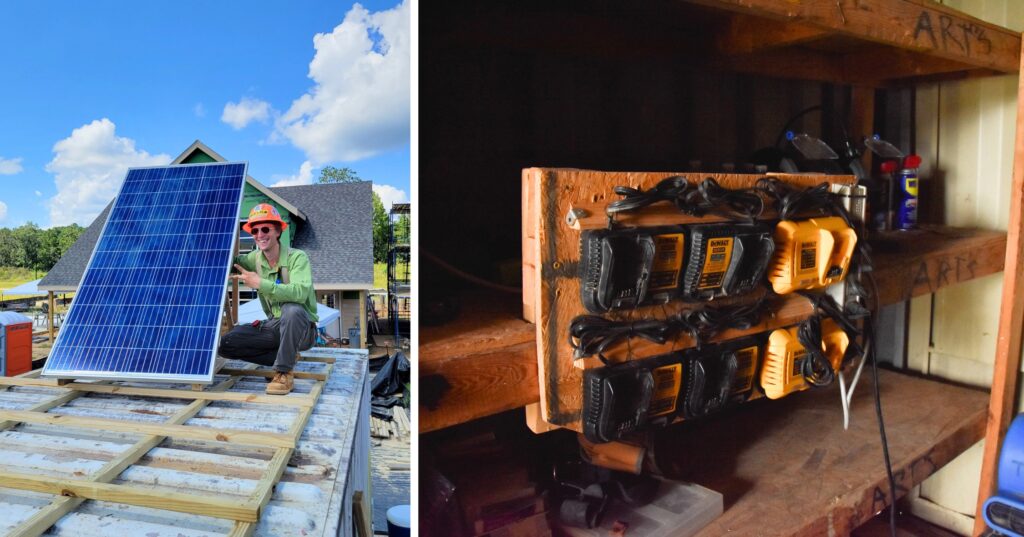
Site supervisor Kevin Deiber poses with the first solar panel, which powered a “nest” (right) of tool batteries that ensured staff and volunteers started the morning with charged batteries.
First, he noticed managing batteries on site was a struggle: on any given day, Habitat staff and volunteers might be using dozens of tools on multiple active townhome sites. With removable batteries and separate chargers, it was hard to keep track of all the moving parts and charging schedules for drills and drivers.
Dmitry had an idea for a solution: what if he brought a couple of small solar panels, added a converter, and put several chargers in one place?
It turned out Habitat had several older-model solar panels in storage that would be perfect for the job. Through Zarbio Laboratories, Dmitry donated everything else needed to make a solar-powered system function: batteries, switches, inverters, wires – in short, everything but the panels themselves.
When the first solar panel went up on top of a shipping container at Weavers Grove last August, some were skeptical. “People were like, are you serious? This seems a little jerry-rigged,” says Orange Habitat site supervisor Kevin Deiber, an early champion of the project. “Now we just take it for granted, like, “Oh, it’s Dmitry’s power. It’ll work.”
The initial set of panels produced more energy than needed for tool batteries, which raised another question: what if we could set up solar power to fuel heavier machinery on site, from saws to air compressors?
Dmitry and the construction team added panels to additional containers. Together, they powered roughly three-quarters of the framing of a five-townhome building the construction team started in February.
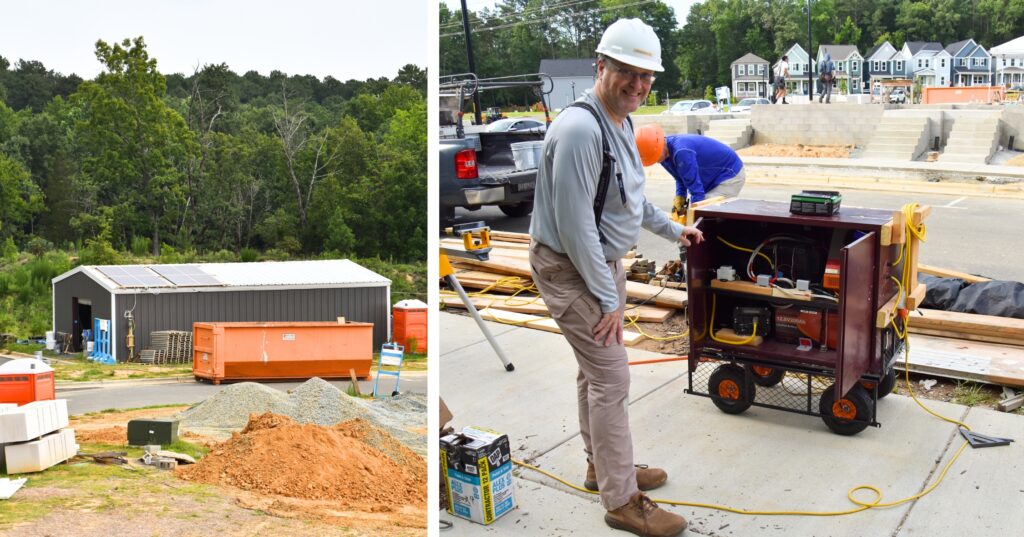
Solar panels on the warehouse, left, now charge batteries in mobile power banks that provide all the energy needed for heavier machinery like chop saws and air compressors. At right, Dmitry shows the interior of one of the mobile carts.
“We ran all the chop saws, we ran circular saws, we ran air compressors for the nail guns – really, that’s all you need for the framing – we ran all of that stuff off of the container. And that was in the wintertime, too,” when there’s less sunlight, Kevin says.
From Dmitry’s perspective, making use of solar isn’t just about being environmentally friendly or saving money: it offers freedom. “Having your own source of energy, solar in this case, gives you independence,” he says. “What solar panels eventually did is provide a local source right where it is needed.” Habitat’s construction work doesn’t consume a lot of kilowatt-hours but often requires bursts of power. “The secret to success is in understanding and satisfying the need,” Dmitry explains.
Later this spring, the team didn’t have to wait for Duke Energy to install temporary poles to power construction in a new townhome building. Dmitry developed a large mobile power bank, mounted on a cart, that could be charged with energy from the solar panels and then rolled anywhere on site.
“It was a life-saver,” Kevin says. “We had no [grid] power for essentially two months of working out there,” but these innovations kept construction on schedule. The system is so effective and reliable that it has become second nature: the construction team uses it just like they would use any traditional power source.
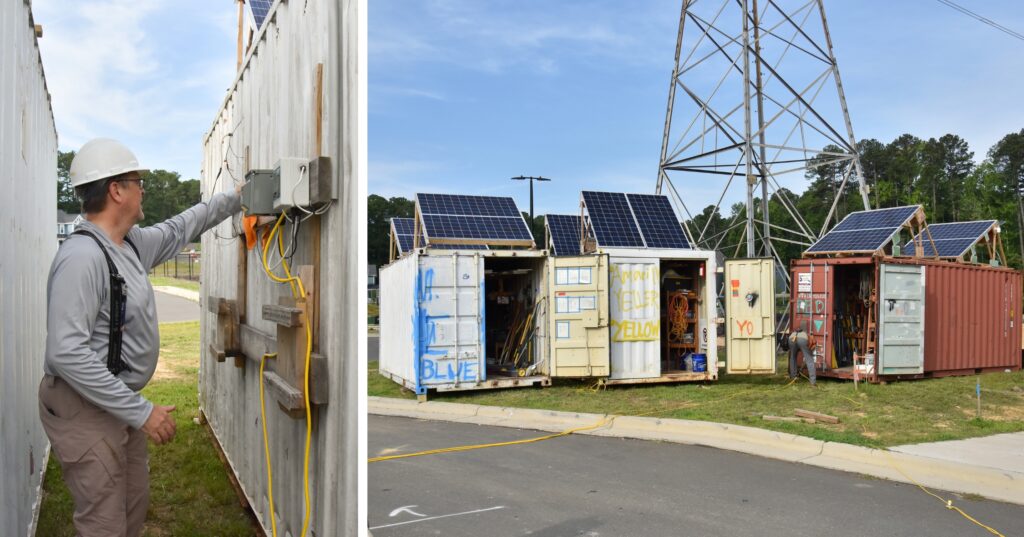
Dmitry designed the solar configuration on these shipping containers to be adjustable: at right, they’re pictured just after having been moved to a new spot, where they’ll be reoriented atop the containers to the best angle for the sun.
The benefits didn’t stop at building tools. On the hottest days, our Volunteer Engagement team was going through six to eight bags of store-bought ice to cool down tubs of water for volunteers and staff. As the solar setup grew, there was enough power to add a fully solar-powered commercial ice machine — quite a power-hungry device. Between staff time saved on trips to the store and ice purchases avoided, the new machine paid for itself within weeks.
Dmitry sees this work as a scientific project. “Habitat allowed me to do the work I wanted to do: I could experiment, and there was no limit to how I could envision it. I was given a “lab” without restrictions…if I can pay you back for this opportunity, it’s ideal business,” he says.
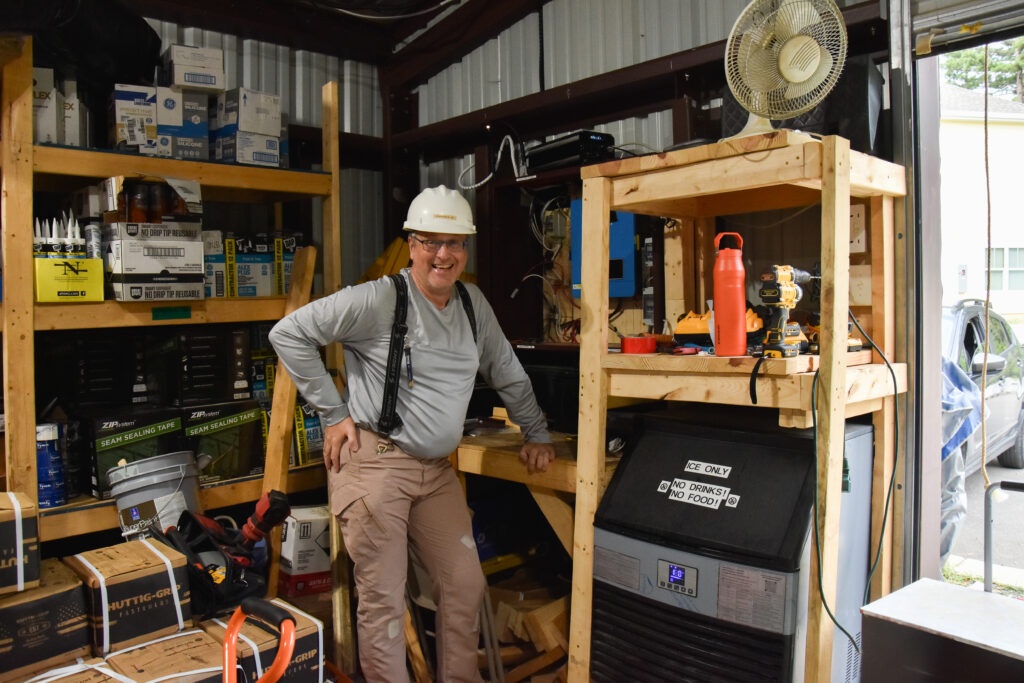
Dmitry with the new ice machine powered exclusively with solar energy. He also dug the 100-foot trench to connect the machine to the nearest water source!
And this is only the beginning. When construction moves to Auman Village next year, the solar array will come with them — and it may continue to grow.
“He always has ideas for making it better, making it lighter, making it more streamlined,” Kevin says. “It’s pretty amazing what he’s done.”
For Dmitry, success means optimizing the workflow — saving staff and volunteers time and increasing productivity across the site. He hopes it doesn’t stop with Orange Habitat: he’s ready to share his ideas with other Habitat affiliates who might benefit from homegrown solar setups.
In the meantime, we’re just grateful for the huge impact he’s had here. Thank you, Dmitry!